


The Identity Thesis: Your North Star Statement That Transforms Confusion into Conviction
Most entrepreneurs have expertise, insights, and transformation to offer. What they lack is the gravitational truth that organizes it all.
You’ve clarified your identity. You’ve explored your perspective. You understand your value. But if someone were to ask you “What’s the one belief that makes your approach necessary?”—the words would scatter before you could speak them.
This isn’t about lacking clarity. It’s about lacking a center, a fundamental truth from which everything else naturally emerges. Without this center, even sophisticated expertise feels fragmented. Your message works in pieces but never quite coheres into something unmistakable.
Your Identity Thesis is that center. Not another positioning statement or brand tagline—the lived belief that makes business decision obvious. Content topics, service offerings, partnership opportunities, platform choices—all become clear when your thesis is named. After this thesis crystallizes, you stop debating what to create and simply express what you know. Content flows. Decisions simplify. The question shifts from ‘What should I say?’ to ‘How do I say what I’ve always known?
What a Crystallized Identity Thesis Gives You
- Decision clarity — Every opportunity filters through one question: “Does this serve my thesis?” The answer is always obvious.
- Content that writes itself — When you know your core belief, topics emerge naturally. You stop asking “What should I post?” because everything connects to the same root.
- Positioning that feels inevitable — Your thesis isn’t something you craft; it’s something you recognize. This means your positioning can’t be manufactured by competitors—it’s authentically yours.
- Compound authority — Every piece of content, every service, every conversation expresses the same truth. Over time, this coherence becomes impossible to replicate.
What an Identity Thesis Actually Is (and Isn't)
Your Identity Thesis is not your mission statement, vision, value proposition, or positioning. Those are strategic documents. Your thesis is the fundamental belief from which strategy emerges—the single conviction that tells you which services to offer, which clients to pursue, and which opportunities to decline.
At Perfect Blend, the thesis that crystallized through years of client work was simple: “What you do instinctively is what others are searching for intentionally.”
This wasn’t marketing copy. It was recognition of a pattern observed repeatedly, that entrepreneurs’ natural approaches contained exactly what their ideal clients needed, but the translation between instinct and language had never been made. Every confusion Perfect Blend encountered in early web design work stemmed from this single gap.
Once named, this thesis explained everything. Why clients struggled with content. Why borrowed positioning felt hollow. Why visibility tactics exhausted rather than energized. The problem was never strategy—it was the unbridged gap between inner knowing and outer expression.
This thesis now generates everything at Perfect Blend: why Strategic Inner Alignment precedes visibility work, why Voice Predicates excavate natural language rather than construct artificial tone, why Visibility Architecture amplifies rather than creates presence. Every methodology, every article, every client conversation stems from that one belief.
A true Identity Thesis has three essential characteristics:
- 1. Lived Truth, Not Aspiration — It must be something you already know through experience, not something you hope might be true. Perfect Blend's thesis emerged from observing the same pattern across dozens of clients, not from strategic positioning sessions.
- 2. Universal Yet Unique — It must be broadly applicable while specifically yours. Others might agree that instinct contains wisdom, but only Perfect Blend expresses it through their particular combination of semantic architecture and voice alignment methodology.
- 3. Generative Power — It doesn't describe what you do, it generates what you create. Perfect Blend's thesis is the seed containing their entire framework. The Voice Alignment Framework, with all its layers and complexity, grows organically from that single belief.
Why Most Entrepreneurs Never Articulate Their Thesis
The challenge isn’t that entrepreneurs lack a thesis. Everyone operating from expertise has a core belief driving their approach. The challenge is that most never make the declaration.
Building on Borrowed Beliefs
Without excavating your own thesis, you unconsciously adopt others’. You read thought leaders and absorb their convictions as your own. These beliefs sound right—compelling, even—but they don’t feel entirely true. Your content works technically but lacks the energetic coherence that creates trust.
In practice, Perfect Blend experienced this in their early years. They’d use language from marketing frameworks that made intellectual sense without fully aligning with their lived experience. The words were accurate but not quite authentic.
Mistaking Activity for Identity
Most entrepreneurs describe what they do rather than declaring what they believe. “I help people achieve X through Y” is a service description, not a thesis. Your thesis is the belief that makes that service necessary.
Before crystallizing their thesis, Perfect Blend would say “We help entrepreneurs build websites that amplify their brand.” True, but descriptive, not generative. The thesis—what you do instinctively is what others search for intentionally—explains why that amplification matters and how it emerges. Everything else flows from that belief.
Never Making the Declaration
The deepest challenge is simply this: naming your thesis requires declaring your truth publicly, in language specific enough to be recognized and broad enough to be meaningful. That declaration feels vulnerable. What if your thesis sounds obvious? What if others disagree? What if it’s wrong?
But a thesis isn’t meant to be universally accepted. It’s meant to be specifically yours—lived, tested, and true enough to organize your entire approach around it.
The Excavation Process: Revealing What Already Exists
Your Identity Thesis is already present. It’s operating in every transformation you facilitate, every insight you share, every decision you make. The work isn’t creation—it’s recognition. You’re naming what’s already been driving your best decisions, your clearest content, and your most successful client work.
Perfect Blend’s excavation took five years, moving through three distinct phases that revealed rather than constructed their thesis.
-
Phase One: Sensing Beneath the Surface — Something was true, but unclear. Perfect Blend recognized that web design was never really about aesthetics—clients who left satisfied weren't happy because their site looked good, but because it felt true. Those who remained uncertain had technically sound and beautiful sites that somehow missed their truth.
In practice — this phase involved noticing patterns without yet naming them. Why did some entrepreneurs' About pages flow easily while others required endless revision? Why did certain brand identities feel immediate while others felt like ill-fitting clothes? The answers weren't in design principles—they were in something deeper.
The sensing phase is uncomfortable because you know something matters without being able to articulate it. This sensing capacity—the ability to recognize patterns before naming them—emerges from integrating mind, heart, and intuition for sustainable presence. -
Phase Two: Naming the Central Truth — Over time, the pattern became impossible to ignore: Entrepreneurs who could describe their natural approach clearly attracted aligned clients effortlessly. Those who tried to adopt strategic positioning struggled with consistency. The ones whose websites felt authentic weren't following better design principles—they were expressing lived truths they'd finally found language for.
The thesis emerged not as a clever insight but as obvious recognition: What you do instinctively is what others are searching for intentionally.
In practice — this naming happened through iteration. Multiple attempts at articulating the core belief, testing each version against actual client experiences, discarding what sounded good but wasn't quite true, keeping only what explained everything. -
Phase Three: Building From Foundation — Once the thesis was clear, everything else became inevitable. Perfect Blend didn't decide to create the Voice Alignment Framework—the framework emerged naturally from their thesis. If instinct contains what others seek, then the work becomes excavation (Strategic Inner Alignment), translation (Voice Predicates), and amplification (Visibility Architecture).
Each methodology is simply a different expression of the same core belief. The thesis doesn't just describe Perfect Blend's work—it generates their work.
The Questions That Reveal Your Thesis
Your excavation begins with honest inquiry:
- What truth appears in every transformation you facilitate? — Not what you hope creates transformation, but what you observe consistently working. This pattern, when named, often reveals your thesis.
- What belief underlies your most passionate explanations? — Notice when you find yourself saying "But what people don't understand is..." The completion of that sentence often points toward your thesis.
- What principle would you defend even if unpopular? — Your thesis doesn't need universal agreement—it needs to be true enough that you'd build your entire approach around it.
- What do you see that others consistently miss? — Your unique perception, when articulated as a belief rather than just an observation, often becomes your thesis.
Your Thesis Excavation Exercise (15 minutes)
Set a timer. Write without editing.
Part 1: Pattern Recognition (5 minutes) Write about your three most successful client transformations (or personal breakthroughs if you’re pre-client). What was present in all three? What did you do or believe that made the difference?
Part 2: The Recurring Sentence (5 minutes) Complete this sentence as many ways as you can: “What most people don’t understand about [your work/expertise] is…” Look for repetition. The belief that appears most often is likely your thesis in disguise.
Part 3: The Declaration Draft (5 minutes) Write one sentence that captures what you believe makes your approach necessary. Don’t polish—just state it.
Testing for Truth vs. Aspiration
Write potential thesis statements, then test each one:
- Have you lived this truth repeatedly? — If your "thesis" describes something you hope will work rather than something you've consistently observed, it's aspiration, not thesis.
- Does everything else flow from it? — A true thesis generates your methodology, your voice predicates, your service structure. If your thesis is true but your work doesn't stem from it, either your thesis or your work needs revision.
- Is it specifically yours? — Others might agree with your thesis abstractly, but can they replicate how you express and apply it? If your thesis could belong to anyone in your field, dig deeper.
- Does this thesis honour your Core Identity? — Beyond professional truth, does your thesis align with who you believe yourself to be fundamentally? If you're experiencing disconnect—when your life's deepest truth and your business work feels worlds apart—this deeper layer needs resolution before your thesis can fully crystallize Your thesis must satisfy both professional accuracy and core identity integrity. A thesis that's true professionally but disconnected from your deepest sense of self will create the same divided energy that strategic positioning creates. When your Identity Thesis flows naturally from your Core Identity, your commitment becomes unconditional because you're building not just a business methodology but an authentic expression of who you fundamentally are.
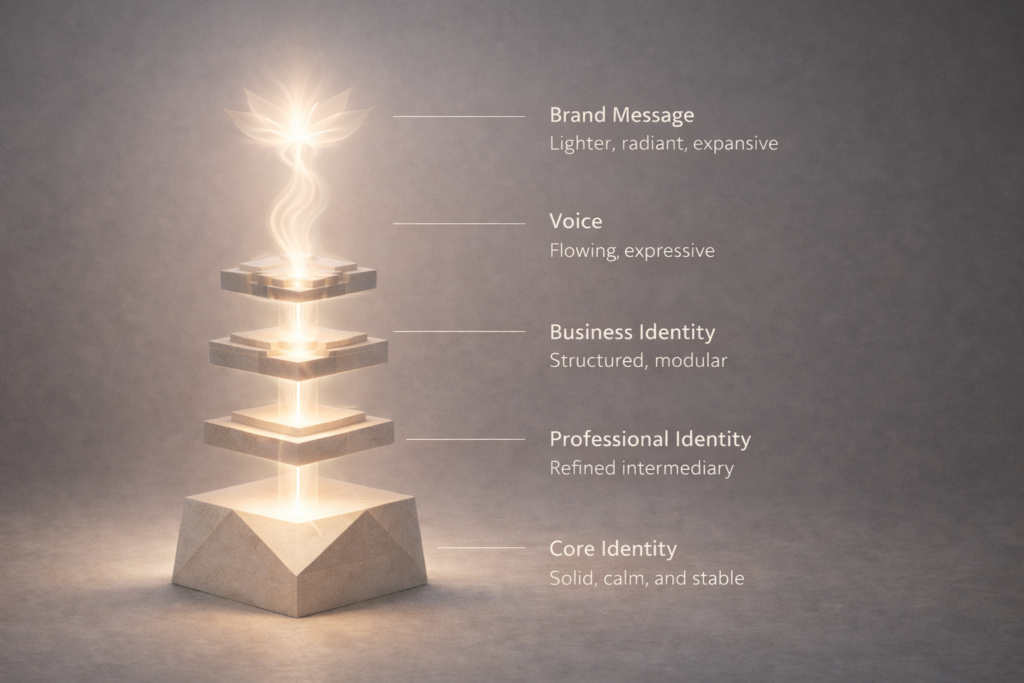
Perfect Blend’s thesis passes these tests: they’ve observed the instinct-to-language pattern for five years across diverse clients, their entire framework flows from this belief, and while others might agree instinct matters, only Perfect Blend has built semantic architecture and voice excavation methodologies around this specific truth.
What You Might Be Thinking
“This sounds like a mission statement with different branding.” Mission statements describe what you hope to accomplish. Your Identity Thesis describes what you already believe to be true. Mission statements are aspirational. Your thesis is observational—a pattern you’ve already witnessed repeatedly. The difference: mission statements guide behavior; your thesis generates it.
“I don’t have five years to figure this out.” Perfect Blend’s thesis took five years to crystallize because they weren’t looking for it. Once you know what you’re excavating, the timeline compresses dramatically. Most entrepreneurs can identify their thesis within weeks of focused attention—because it’s already operating. You’re not building; you’re recognizing.
“What if my thesis turns out to be too simple or obvious?” Then you’ve found it. The most powerful theses feel obvious once named—that’s how you know they’re true. Perfect Blend’s thesis (“What you do instinctively is what others are searching for intentionally”) isn’t complex. It’s obvious in retrospect. But it organizes everything. Complexity isn’t the goal; generative power is.
“What if my thesis changes as I evolve?” Your thesis might deepen, but it rarely changes fundamentally. What evolves is how you express and apply it. Perfect Blend’s thesis hasn’t changed in five years—but how they apply it (Strategic Inner Alignment, Voice Predicates, Visibility Architecture) continues to expand. Evolution happens in application, not foundation.
“I already know my beliefs—I just can’t articulate them.” Then you’re closer than you think. The excavation questions in this article aren’t about finding something hidden; they’re about naming what you already sense. Most entrepreneurs can feel their thesis operating—they just haven’t given it language. The work is translation, not discovery.
From Thesis to Semantic Architecture
Once your Identity Thesis crystallizes, it becomes the root of your entire semantic ecosystem. This isn’t metaphor—it’s the actual structure of how compound authority builds.
Identity Thesis → Voice Pillars
Your thesis naturally generates your main territories of exploration. This progression from Identity Thesis to Voice Pillars to Topic Clusters is the foundation of organizing your expertise into discoverable territories.
Strategic Inner Alignment: If instinct is what others seek, then excavating that instinct becomes the foundational work.
Voice Alignment: Instinct must become language—predicates, patterns, and expression that translate inner knowing to outer communication.
Visibility Architecture: Once aligned and articulated, presence must be amplified through semantic structures that honour the original truth.
Sustainable Authority: Building from instinct rather than imitation creates compound rather than fragmented growth.
These aren’t categories Perfect Blend chose strategically—they’re the inevitable expressions of their core belief.
Voice Pillars → Topic Clusters
Each pillar contains topic clusters that explore different facets while maintaining semantic coherence. These clusters don’t drift because they’re all rooted in the same thesis.
Under Strategic Inner Alignment, Perfect Blend explores identity clarity, self-recognition, alignment versus drift—all different angles on the same belief that instinct contains what others seek, so excavating that instinct is the primary work.
Topic Clusters → Semantic Network
Topics connect through natural dependencies—concepts that must be understood in sequence. Your Identity Thesis determines these learning paths automatically.
Someone searching for “authentic business voice” might discover Perfect Blend’s Identity Clarity Framework, which introduces Strategic Inner Alignment, which references Voice Predicates, which connects to Archetypes—each article a different expression of the same root thesis.
The Compound Effect
When everything stems from one truth, each piece strengthens the whole. Perfect Blend’s 100th article makes their first article more valuable because both emerge from the same thesis. Their authority compounds rather than scatters.
This only works when the foundation is singular. Multiple theses create fragmentation. One thesis, deeply lived and systematically expressed, creates coherence that becomes increasingly difficult to replicate.
Living From Your Thesis
Once your Identity Thesis is clear, it becomes your decision filter for everything:
- Does this service express my thesis? — Perfect Blend could offer generic SEO optimization, but unless it serves their thesis—helping entrepreneurs translate instinct into discoverable language—it creates fragmentation.
- Does this content stem from my thesis? — Every article Perfect Blend creates explores a different facet of how instinct becomes intentional search, how inner knowing becomes outer expression. Content that strays from this thesis, however interesting, weakens rather than strengthens their authority.
- Does this opportunity align with my thesis? — Perfect Blend receives requests for various marketing services. Their thesis makes the decision simple: if it helps someone name and express what they already know instinctively, it aligns. If it constructs something artificial, it doesn't.
In practice — living from your thesis means your presence becomes coherent across every context. Your website, your content, your conversations, your services—all expressions of the same core belief. This coherence is what creates trust before someone ever becomes a client.
Your Thesis Is Already Operating
The most profound aspect of Identity Thesis work is this: you’re not finding something new. You’re recognizing what’s been true all along.
Every transformation you’ve facilitated, every insight you’ve shared, every decision that felt right—they all spring from the same source. Your Identity Thesis has been operating beneath your awareness, shaping your approach even without language to name it.
The excavation process simply brings it into view. Once named, you can build from it systematically rather than unconsciously. Your entire presence can express what you’ve always known rather than what you think you should say.
As Perfect Blend discovered, the journey from sensing to naming to building isn’t about becoming something new—it’s about finally speaking with full clarity what was always true.
Your Identity Thesis is the foundation of sustainable visibility.
Perfect Blend Marketing & Design Inc. specializes in a comprehensive methodology for building sustainable visibility from authentic identity for service professionals, consultants, and purpose-driven entrepreneurs. Through our proprietary Voice Alignment Framework & Strategy™, we transform scattered voices into systematic authority. We encourage you to continue deeper into the framework where identity clarity transforms into aligned expression.
Related Identity Anchors:
Begin Your Journey:
This article is part of Perfect Blend’s Identity Anchor series—foundational content that establishes the semantic architecture of aligned visibility.


